
Wordle strategies for beginners: simple ways to win more often

If you are new to Wordle and feel a bit lost, you are not alone. Every day thousands of players look for
simple, reliable Wordle strategies that actually help them win more often, not just clickbait tips.
In this guide for beginners, we will walk through practical strategies for Wordle, from basic habits
and starting words to more advanced ideas like the Wordle algorithm and data-based tactics.
1. What makes a good Wordle strategy for beginners
Before you copy a list of "best words" from the internet, it helps to understand what a Wordle strategy
actually tries to do. In simple terms, a good Wordle strategy for beginners should:
- Help you discover as many new letters as possible in the first 1–2 guesses.
- Reduce the number of possible answers quickly using color feedback.
- Avoid wasting guesses on letters and patterns that are statistically rare.
- Be easy to remember and use, even when you are half asleep in the morning.
There are advanced approaches, including mathematical models and something people call the
"Wordle algorithm", but you do not need to be a statistician to start winning more often.
We will move from simple Wordle strategies for beginners to more advanced ideas step by step.
2. Basic Wordle strategies for complete beginners
Let us start with the foundations. These simple strategies for Wordle are easy to apply right now,
even if you have never thought about probability or data.
2.1 Use a smart first guess, not a random one
Many players type the first five-letter word that comes to mind. That feels fun, but it is rarely efficient.
A better Wordle strategy is to start with a word that:
- Contains 2–3 common vowels (A, E, O, sometimes I or U).
- Includes common consonants like R, S, T, L, N, C.
- Does not repeat letters.
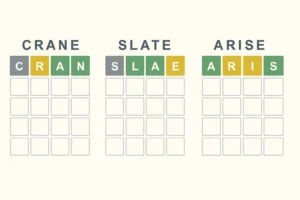
Classic examples are words like "CRANE", "SLATE", "ARISE", "SALET" or "CRATE". They are not magic, but they
follow the same principle: test a mix of very common letters as early as possible.
2.2 Do not reuse gray letters
It sounds obvious, but one of the biggest leaks in most beginner Wordle strategies is accidentally
reusing gray letters. If a letter is gray, it means it is not in the solution at all. Typing it again
in a later guess is pure waste.
After each guess:
- Mental note or write down the gray letters you must avoid.
- Try to build new guesses only with letters that are green, yellow or not tested yet.
2.3 Use yellow letters aggressively
A common mistake is to keep playing almost the same word after you get yellow letters.
If you get a yellow "A" and "R", for example, but in different positions, you should build the next guess
around these letters and move them to new spots, not ignore them.
2.4 Treat guess 2 and 3 as "information turns"
Instead of trying to solve the puzzle in guess 2, focus on collecting information:
- Use new letters where possible, especially in guess 2.
- Combine what you know from greens and yellows with 2–3 fresh letters.
- Only go for a "solution guess" when there are just a few possibilities left.
This approach alone can dramatically improve your success rate with Wordle strategies for beginners.
3. Best starting word strategies in Wordle
If you search for "Wordle strategies" or "best Wordle strategy", you will often find debates about the
statistically best Wordle starting word. People run simulations over the full answer list to see which
word solves the most puzzles on average.
3.1 The idea behind a "statistically best Wordle starting word"
When people talk about the statistically best Wordle starting word, they usually mean a word that:
- Maximizes the chance of turning some letters green or yellow on the first guess.
- Minimizes the average number of guesses needed to reach the solution across all answers.
- Uses letters that are very frequent in English five-letter words.
Words like "SALET", "CRANE", "SLATE" or "CRATE" are favorites in many data-driven analyses.
You do not need to use the same word as everyone else, but choosing a consistent, vowel-rich starting word
is one of the simplest and most powerful strategies for Wordle.
3.2 Should you always use the same starting word?
Using the same starting word every day has pros and cons:
- Pros: You get very familiar with its patterns and how typical feedback looks.
- Cons: You might miss some specific letter combinations that a different word would find faster.
A balanced approach is to keep 2 or 3 favorite starting words. Rotate between them depending on mood or
how risky you feel on that day.
3.3 What are the two best words to start Wordle?
Many players like to open with one word that targets vowels and common consonants, then use a second word
to cover the letters that were not tested yet. For example:
- First guess: "CRANE" (common vowels and consonants).
- Second guess: "SOULP" or "MISTY" (tests different letters, depending on feedback).
There is no single correct pair, but the pattern is clear: use your first two guesses to test as many
frequent letters as possible without repeating grays unnecessarily.
4. Advanced Wordle strategies based on algorithms and tools
Once you are comfortable with basic Wordle strategies for beginners, you might get curious about terms
like "Wordle algorithm", "Wordle solver algorithm" or "Wordle analysis tool". These ideas come from
trying to formalize the game as a problem that a computer can solve efficiently.
4.1 What is the Wordle algorithm?
There is no single official Wordle algorithm, but many programmers and mathematicians have built their own.
In general, a Wordle algorithm:
- Starts from a list of all possible answers.
- Simulates how each guess partitions the remaining options based on green, yellow and gray feedback.
- Chooses the guess that will, on average, reduce the candidate list the most.
For you as a player, this translates into a simple principle: your next guess should dramatically reduce the
number of possible answers, not just "feel" like a solution.
4.2 Wordle solver algorithms and tools
A "Wordle solver algorithm" is basically an automated version of a very disciplined human player.
Many websites and apps implement this logic to suggest optimal guesses. They often present themselves as:
- Wordle solver tools.
- Wordle analysis tools.
- Wordle data analysis dashboards.
Using a Wordle solver pro style tool can be educational. You can:
- Enter your guesses and see how a computer would narrow down the options.
- Compare your instinctive strategies with the solver’s suggestions.
- Learn which patterns the algorithm considers strong or weak.
4.3 Should beginners rely on solvers every day?
As a beginner, treat solvers and computer-generated hints as a learning resource, not a permanent crutch.
If you use them occasionally to understand how algorithms think, your own Wordle strategies will naturally
become more disciplined and efficient.
5. The hardest Wordle words (and what to learn from them)
Some answers are famous for being painfully difficult. When people ask for the hardest word to guess in Wordle,
two examples appear again and again: "VOZHD" and "WAQFS". These answers live in many players’ nightmares.
5.1 Why words like VOZHD and WAQFS are so hard
Words such as "VOZHD" or "WAQFS" are tough because they:
- Use very rare consonants like V, Z, J, Q, W, F.
- Contain letter combinations that almost never appear in casual vocabulary.
- Make it easy to burn 3 or 4 guesses testing common letters that are not in the answer at all.

5.2 How to handle extremely rare answer patterns
You cannot predict every rare answer, but you can adapt when your usual strategy fails:
- Notice when very common letters (R, S, T, L, N) keep turning gray.
- Be willing to test "weird" letters like J, Q, X, Z once the obvious patterns are exhausted.
- Use your fifth guess as a "searchlight" to test several rare letters at once if needed.
Even if you do not win every time, this flexible mindset is part of a solid Wordle strategy.
6. Wordle tips and tricks for everyday play
To close the loop, here is a quick collection of practical Wordle tips and tricks you can apply right away
in your daily games.
- Decide on 1–3 favorite starting words and stick with them for a while to learn their behavior.
- Keep track of gray letters and avoid them completely in later guesses.
- Use guess 2 and 3 to collect information, not to "force" a solution too early.
- When stuck, try a guess that tests several new letters instead of repeating old patterns.
- Practice reading yellow and green patterns as clues to likely letter positions.

7. Today’s Wordle answer and daily hints
Strategy is great for long-term improvement, but sometimes you just want to know whether you solved
today’s puzzle correctly or need a gentle nudge. On our main hub
hintsfortodayswordle.com
you can find fresh hints and updates every day.
Below you will see the latest entry with today’s Wordle answer and related hints:
8. FAQs about Wordle strategies for beginners
What is the best Wordle strategy for beginners?
The best Wordle strategy for beginners is simple and consistent. Pick a strong starting word with
common letters, avoid reusing gray letters, and treat your early guesses as information turns.
Do not rush to solve the puzzle in guess 2. Instead, use your first 3 guesses to map out which letters
are in play and where they could go.
Is there a single statistically best Wordle starting word?
Different analyses suggest slightly different winners, but several data-driven studies agree that words
like "SALET", "CRANE", "SLATE" or "CRATE" perform very well over the full answer list.
For most players, the exact ranking is less important than using a consistent starting word that tests
a good mix of common vowels and consonants.
Do I need a Wordle solver or algorithm to win consistently?
No. Solvers and algorithms are useful to understand how the game can be optimized, but they are not
required to win regularly. If you apply the basic Wordle strategies in this guide, you can reach a very
high win rate without any external tool. You can always experiment with a Wordle analysis tool for
learning, then return to manual play with stronger intuition.
How often should I change my Wordle strategy?
Try to stick with the same core strategy for at least a week or two. This gives you enough games to see
how it behaves on different types of answers. If you constantly change your approach, it is hard to know
whether you are improving or just getting lucky. Adjust one element at a time, such as your starting word,
and observe the impact.
If you want to explore more ideas, guides and daily hint formats around Wordle strategies,
remember to visit the main hub at.
As your experience grows, you can revisit this page and refine your own personal Wordle strategy using the
concepts we covered here.